
- Paper & Packaging Testing Instrument
- Textile Testing Instrument
- Plastic & Rubber Testing Instrument
- PU Foam Testing Instrument
- Pet & Preform Testing Instrument
- Test Chamber /Hot Air Ovens
- Footwear Testing Instrument
- Tensile Testing Machine
- Tensile Strength Testing Instrument
- Industrial Ovens
- Muffle Furnace
- GSM Testing Instrument
- Fabric Testing Instruments
- Yarn Testing Instrument
- Hot Plate
- Conditioning Chamber
- Humidity Chamber and Incubator
- Universal Testing Machine
- Strength Testing Instruments
- Textile Dyeing Machinery
- Garment Testing Equipments
- GSM Cutter
- GSM Scale
- Dumbbell Cutting Press
- Gravity Balance
- Drape Meter
- Bursting Strength Testing Instrument
- Transparency Testing Instrument
- Elongation Testing Instrument
- Ageing Oven
- Extensometer
- Fatigue Testing Instrument
- Bundesmann Apparatus
- Colour Matching Cabinet
- Crock Meter
- Fastness Testing Instrument
- Swatch Cutter
- Abrasion Testing Instrument
- Pilling Testing Instrument
- Water Bath
- Gloss Meter
- Box Compression Testing Instrument
- Rotary Shaker
- Cable Connector Mating Cycle Tester
- Coefficient of Friction Tester
- Dart Impact Tester
- Bottle Perpendicularity Tester
- Base Clearance Membrane
- Martindale Abrasion Cum Pilling Tester 4 Head
- CBR Punchutre Strength Tester
- CBR Puncture Strength Tester
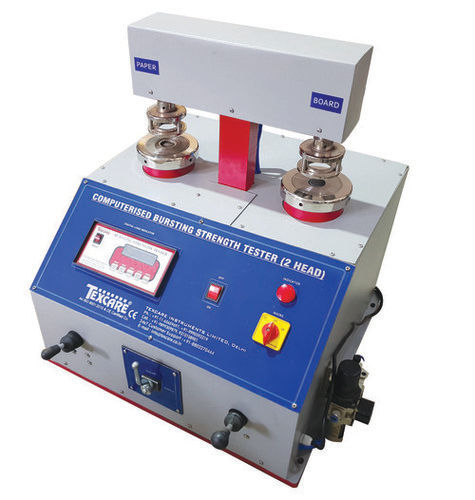

Bursting Strength Tester Analogue
45000.00 INR/Unit
Product Details:
- Temperature Up to 45C (Operation)
- Specimen Size Approx 30 mm diameter
- Humidity Up to 85% RH (Operation)
- Number of Specimens Single Specimen at a Time
- Test Material Paper, Corrugated Board, Fabric
- Gas Pressure Not Applicable (Hydraulic Operation)
- Test Range 035 kg/cm (standard), 07 kg/cm / 070 kg/cm (optional)
- Click to View more
X
Bursting Strength Tester Analogue Price And Quantity
- 45000.00 INR/Unit
- 1 Unit
Bursting Strength Tester Analogue Product Specifications
- Paper, Corrugated Board, Fabric
- Approx 45 kg
- 500 mm x 400 mm x 530 mm (Approx)
- Not Applicable (Hydraulic Operation)
- 035 kg/cm (standard), 07 kg/cm / 070 kg/cm (optional)
- NA (Manually Operated)
- Analogue
- Mild Steel (Powder Coated)
- Laboratory, Industrial Testing
- Approx 30 mm diameter
- Up to 85% RH (Operation)
- Up to 45C (Operation)
- Measures Bursting Strength of Paper, Cardboard, Fabric
- Manual Operation
- Single Specimen at a Time
- Glycerin or Brine
- Supplied with Calibration Certificate
- Powder Coated
- Hand Wheel with Rubber Diaphragm
- Analogue Dial
- Bourdon Tube Analogue Gauge
Bursting Strength Tester Analogue Trade Information
- Cash Advance (CA), Cash in Advance (CID)
- 20 Unit Per Week
- 15 Days
- Contact us for information regarding our sample policy
Product Description
Bursting Strength Tester Analogue offered by us, is a reliable method of determining the strength and performance of materials. There will be no slippage if the specimen is tightened evenly with the operating wheel. This has easy installation, will great precision, and excellent performance. There is also a calibration facility. Bursting Strength Tester Analogue has a grooved construction. Under multidirectional force, highly accurate test results are obtained. The Test Specimen Holder to keep the specimen under test from slipping and to keep it intact.
Specification
|
Fluid Displacement Rate |
95 cc/Minute |
|
lower clamp Opening |
30.5 mm |
|
Upper Clamp Opening |
31.5 mm |
|
Test Fluid Tank Capacity |
160 ml |
|
Test Fluid |
Glycerin |
|
Power |
220 Volt AC 50 Hz |
|
Motor |
1/4 HP Geared Motor |
|
Maximum Capacity |
35 kg/cm2 |
Durable Analogue Testing Solution
Featuring a powder-coated mild steel construction and a manually operated system, the Bursting Strength Tester is designed for longevity and consistent results. The analogue dial provides clear readings, while the hand wheel clamping ensures secure specimen placement during tests.
Versatile Applications and Test Range
Engineered for both laboratory and industrial testing, this tester accommodates a range of specimens including paper, corrugated board, and textiles. The standard test range is 0-35 kg/cm2, with optional lower or higher ranges available. Its operation is tailored for environments up to 85% relative humidity and temperatures up to 45C.
Certified for Accurate Results
Each Bursting Strength Tester is supplied with a calibration certificate, ensuring that every measurement meets precision requirements. The hydraulic operation, using either glycerin or brine, allows you to test materials with confidence and repeatability.
FAQ's of Bursting Strength Tester Analogue:
Q: How does the Bursting Strength Tester Analogue work?
A: This tester functions through manual operation, where a single specimen is clamped with a hand wheel over a rubber diaphragm. Hydraulic pressure (using glycerin or brine) is applied until the specimen bursts, and the analogue gauge displays the bursting strength.Q: What materials can be tested with this instrument?
A: The tester is designed for paper, cardboard, fabric, and corrugated board specimens with an approximate 30 mm diameter. It is suitable for both laboratory evaluations and industrial quality checks.Q: When is recalibration necessary for optimal accuracy?
A: Recalibration should be performed as per your laboratory's or industry's quality control protocols. Since the instrument is supplied with a calibration certificate, routine checks at intervals recommended by your standards body are advised to ensure ongoing accuracy.Q: Where can this bursting strength tester be used?
A: It is suitable for laboratories, manufacturing facilities, and industrial testing environments in India and abroad, wherever material strength validation is required.Q: What is the process for setting up a test?
A: Place the specimen on the tester, secure it using the hand wheel mechanism, and fill the chamber with glycerin or brine as the test fluid. Gradually increase pressure manually until the sample bursts, reading the value directly from the analogue dial.Q: What are the advantages of the analogue dial with Bourdon tube gauge?
A: The analogue dial with a Bourdon tube gauge offers immediate visual readings, is simple to operate and maintain, and does not require electrical power, making it reliable and cost-effective in varied testing environments.Tell us about your requirement

Price:
Quantity
Select Unit
- 50
- 100
- 200
- 250
- 500
- 1000+
Additional detail
Mobile number
Email

Other Products in 'Fabric Testing Instruments' category


Contact Details

- I-84, Road No. 19, UPSIDA Site-C, Surajpur Industrial Area, Greater Noida - 201306, Uttar Pradesh, India
- Phone : 91--9990592219
TEXCARE INSTRUMENTS LIMITED
GST : 09AAGCT7368F1ZW
GST : 09AAGCT7368F1ZW

- texcareinstruments@gmail.com
- Mr. Deepak Sachan (Director)
Mobile : +919899309879, +91-9990592299
Sales : +91 9990592219, +91 9220614277
Technical Support : +91-9310108904
24x7 Customer Support : +91-8802270444
Email : info@texcare.co.in
 Send Inquiry

|


 Send Inquiry
 Send SMS
TEXCARE INSTRUMENTS LIMITED
All Rights Reserved.(Terms of Use)
Developed and Managed by Infocom Network Private Limited.
Developed and Managed by Infocom Network Private Limited.


 English
 Spanish
 French
 German
 Italian
 Chinese (Simplified)
 Japanese
 Korean
 Arabic
 Portuguese